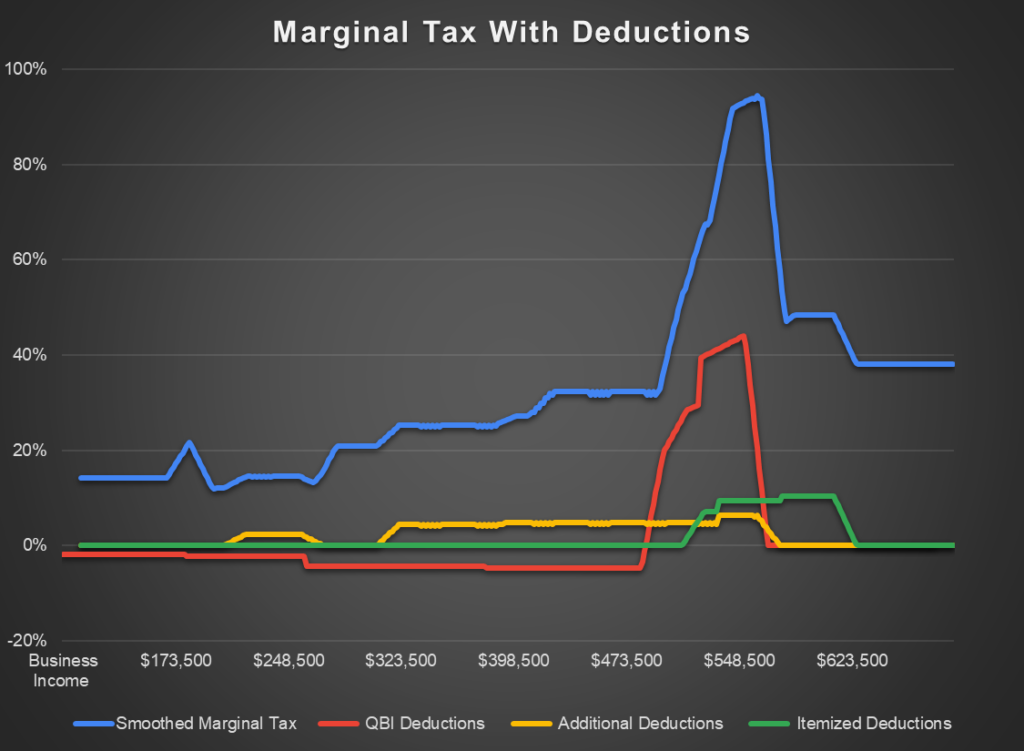
Ask three tax pros when an S-Corp becomes worthwhile and you may get three different answers: $60k, 100k, $150k. The problem is that all three answers can be right or very wrong. Your client could have $250k of net income and an S-Corp would lose them money, because income is not the only variable.
Besides net income, you need to consider reasonable compensation, outside wages, health insurance, and the impact on Social Security benefits.
Using TaxFare’s Tax Planning Calculator, we analyzed three scenarios to identify these thresholds under different assumptions.
What does “worth it” mean?
First, ask the client how much an S-Corp needs to save them to be a win? One owner may consider $1,000 in tax savings a win. Another may need $10,000 to justify the hassle.
Define the client’s goal, then calculate when the election achieves it after accounting for every variable.
For our examples below we will assume that the client wants at least $3,000 in net annual savings to make it worthwhile.
What Are the Extra Costs of Running an S-Corp?
S-Corp’s costs often go well beyond preparing the additional tax return. Clients also need a reasonable compensation study and an accountable plan, both of which you should charge for. Payroll may cost about $600 per year, while inadequate bookkeeping can add thousands more.
For the purposes of these examples assume $2,600 in additional annual administrative costs.
We will model three scenarios for a single taxpayer and change one major factor in each scenario to see how the result moves. We are assuming in these scenarios that their reasonable compensation is $55k per year and we graph the savings as income increases.
Scenario 1
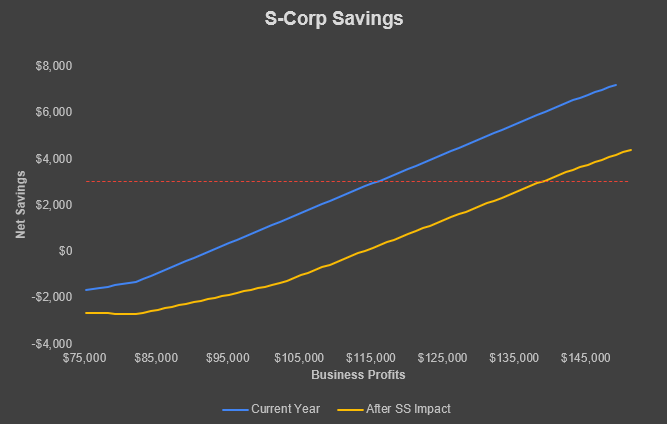
The blue line shows current-year tax savings. The yellow line reduces those savings by the estimated present value of Social Security benefits lost because of lower wages. The dotted red line marks our $3,000 annual savings target.
Here, the S-Corp reaches the $3,000 net savings threshold at $116,000 of profit.
What about future Social Security benefits?
Lower wages can save taxes now but reduce Social Security benefits later. That tradeoff may matter less to younger owners and more to those approaching retirement.
To illustrate that effect, we also modeled a 45-year-old taxpayer with a steady earnings history to calculate net savings after accounting for the present value of the impact on future benefits.
Results show savings only become positive at $114,000 profit, reaching the $3,000 target at $139,000.
Scenario 2: The owner pays for health insurance
Scenario 2 adds $8,400 in annual health insurance premiums to the same base assumptions.
While the self-employed health insurance deduction applies to both structures, SEHI can be counted as part of the client’s Reasonable Compensation. The premiums are included in Box 1 of the shareholder’s W-2 and then deducted on Form 1040, so that portion is largely a wash. However, the premiums are not included in Social Security or Medicare wages, which can provide an additional advantage.
In this case, the $3,000 net-savings threshold is reached at $107,000 of business profit. To reach the same savings as the prior example, you can have $9k less in net income.
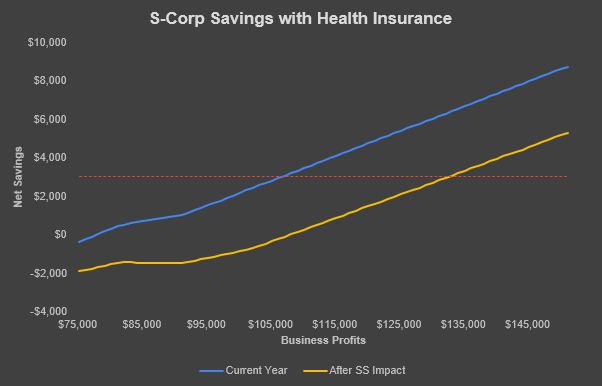
Health insurance lowered the threshold here, but its value varies based on premium costs, other household income, and how the premiums are paid and reported.
A tax professional can enter the client’s actual premiums and other information into the TaxFare calculator rather than relying on a general estimate.
Scenario 3: The owner also has a W-2 job
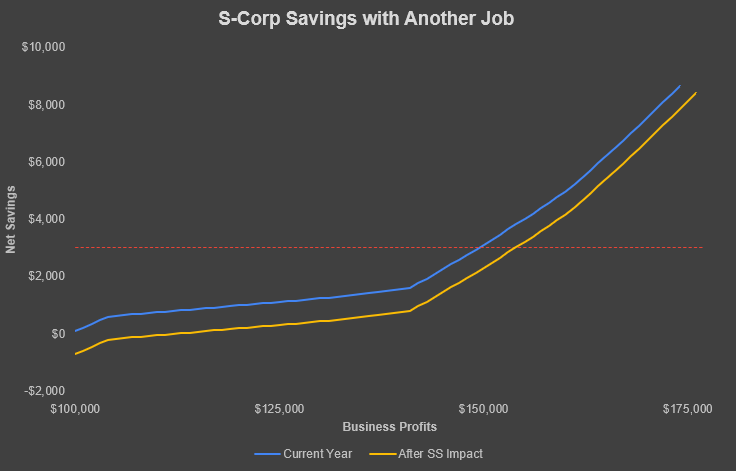
Scenario 3 removes health insurance but includes an outside W-2 job paying $80,000 per year.
Outside wages can reduce S-corp advantages because the owner reaches the Social Security wage base sooner, leaving less payroll-tax benefit for someone who already earns substantial wages from another job.
The outside job also affects taxable income, marginal tax rates, the qualified business income deduction, and other parts of the comparison.
With this income, the S-corp election doesn’t hit the $3,000 target until profit reaches $151,000.
Comparing the three scenarios
The bottom line: In our three examples, the profit required to generate $3,000 of annual net savings ranged from $107,000 to $151,000. After accounting for the potential effect on Social Security benefits, the thresholds increased to $133,000 to $155,000.
| Scenario | Current-year threshold | Threshold after SS impact |
| Business income only | $116,000 | $139,000 |
| $8,400 of health insurance premiums | $107,000 | $133,000 |
| $80,000 outside W-2 job | $151,000 | $155,000 |
Use client-specific numbers instead of a rule of thumb
There is no magic income level at which every business owner should elect S corporation status. In these examples alone, the threshold for producing $3,000 of annual savings varied by $44,000.
Reasonable compensation, health insurance, outside wages, QBI, filing status, retirement contributions, tax credits, and Social Security all affect the result. A rule of thumb cannot account for those interactions.
The right question is not, “How much profit does the business earn?” It is, “At what profit level does an S corporation produce enough real savings for this particular client?”
That is the calculation TaxFare designed its tax calculator to perform.