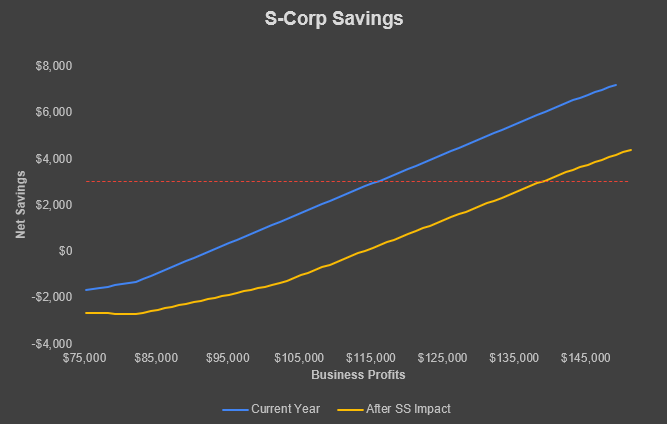
For many small business owners, an S-corp election can reduce payroll taxes. By taking a reasonable salary and distributing the remaining profit as S-corporation distributions, an owner reduces the amount of income subject to Social Security and Medicare taxes.
Most S-corp calculators show the tax savings. They don’t show what those lower wages might cost the client later.
That is the tradeoff tax professionals need to understand. The S-corp election may reduce payroll taxes today, but it can also reduce the wages used to calculate future Social Security retirement benefits.
The S-corp tradeoff: lower Social Security wages, more cash flow today
The key question when deciding to make an S-corp election is not simply:
“How much tax can we save this year?”
The better question is:
“How much tax can we save today, and what is the estimated long-term cost, if any, to future Social Security benefits?”
This is one reason that TaxFare’s Tax Calculator was built: to help tax professionals compare the immediate tax savings of entity planning with the potential long-term Social Security impact.
The net effect can vary wildly. If a business owner already has 35 strong earning years, one additional lower-wage year may have no impact. But if the taxpayer has a shorter work history, years with low wages, and is nearing retirement, additional Social Security earnings may be much more valuable than the yearly savings.
The bottom line: the closer someone is to retirement and the lower their wage history, the more important it becomes to maximize wages to increase projected Social Security benefits.
How TaxFare helps tax professionals show the full picture
TaxFare was created because we could not find an S-corp tax calculator that handled the full complexity of entity planning. Many calculators focus on the obvious payroll tax savings, but do not fully account for QBI, wage deductions, and the secondary effects of changing how business income is reported.
We built TaxFare’s Tax Calculator to go beyond a simple estimate of self-employment tax savings. The calculator is designed to help tax professionals compare the immediate tax impact of an S-corp election with other planning consequences that can affect the client’s overall result.
TaxFare’s Social Security PV calculation goes another step further.
This was not a simple add-on. TaxFare recreates the logic behind the Social Security benefit calculation, estimates how changes in wages affect future benefits, and then converts those projected benefits into a present value using actuarial assumptions.
Isn’t Social Security Going Bankrupt?
One common pushback we hear is, “Social Security is going bankrupt, and I’ll never see a dime when I retire.”
We have two responses. First, Social Security is the third rail of American politics. Neither party wants to be seen cutting benefits, especially because retirees vote and have paid into the system for decades.
Second, even if Congress does nothing, Social Security benefits would not disappear completely. They would be reduced. Current projections show the trust fund shortfall beginning in 2032. If Congress does nothing, ongoing revenue would still cover 78% of scheduled benefits. That is a serious cut, but it is not the same as benefits disappearing.
Married taxpayers: spousal and survivor benefits matter too
Social Security planning is not just about one worker’s retirement benefit.
A spouse may be eligible for benefits based on the worker’s record. In general, a spouse’s benefit can be as much as 50% of the worker’s benefit, depending on age and other eligibility factors.
Survivor benefits can also be significant. A surviving spouse may receive up to 100% of the deceased spouse’s benefit, and eligible children may also qualify.
That means reducing one spouse’s Social Security-covered wages may affect more than that person’s retirement projection. It may also affect the household’s broader retirement income picture.
For married business owners, especially when one spouse does not work or has a limited earnings history, the Social Security side of the S-corp analysis deserves extra attention. We provide an option in our model to include spousal benefits.
S-corp savings should not be analyzed in isolation
A good S-corp analysis should not stop at payroll tax savings. It should also consider the client’s age, earnings history, years until retirement, marital status, and whether a spouse may rely on spousal or survivor benefits.
The best planning shows both sides clearly: the payroll tax savings the client may receive today, and the potential Social Security cost those savings may create later.